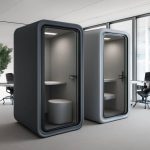
What Is an Office Booth and Why It Matters Now
An office booth is a compact, self-contained space engineered to deliver privacy, acoustics, and comfort within open-plan environments. Often referred to as a phone booth, pod, or micro-room, it creates a controlled bubble where conversations stay confidential and distractions fade. As hybrid work and activity-based planning reshape floorplates, the booth has become a strategic tool to rebalance openness with individual focus and confidential collaboration.
Modern workplaces struggle with noise spikes, visual interruptions, and the constant tug-of-war for meeting rooms. An acoustically treated booth answers these pain points without the cost, complexity, or permanence of traditional construction. Instead of building new drywall enclosures, facility teams deploy modular units in days, then reconfigure them as teams grow, shrink, or re-stack floors. This agility supports evolving headcounts, new work modes, and the seasonal demands of sales calls or project sprints.
Privacy is more than comfort; it is a compliance issue. HR conversations, candidate interviews, legal briefings, and healthcare-related queries require spaces that demonstrate due diligence. A well-designed booth keeps speech intelligibility low outside the enclosure, reducing the risk of incidental disclosure. Advanced ventilation, glare-controlled lighting, and adjustable furnishings also elevate well-being by limiting fatigue and enabling posture changes. These details turn each minute inside a pod into higher-quality time, whether for video meetings or deep work.
Cost efficiency strengthens the case. Compared to a built room that ties up capital and time for permitting, trades, and finishes, a booth offers a predictable, often lower total cost of ownership. It scales in small increments, letting organizations match capacity to real demand. When the lease ends, the investment moves with the company. For teams evaluating choices, the right office booth balances acoustics, ergonomics, ventilation, and technology integration to deliver tangible productivity gains without over-complicating facilities management.
Design, Acoustics, and Health: The Anatomy of a High-Performing Booth
Performance starts with the shell. Multi-layer wall assemblies combine dense cores, decoupled structures, and acoustic seals to limit transmission and resonance. The goal is to reduce conversational intelligibility, not merely to “muffle” noise. While ratings vary by standard, high-quality enclosures often target speech privacy through controlled decibel reduction and thoughtful absorption inside the cabin to prevent echo on calls. Door systems with robust gaskets and laminated glass are critical; a strong wall without an effective seal defeats the purpose.
Inside the booth, acoustic balance matters as much as isolation. Soft, sound-absorbing linings tame reverberation, ensuring voices sound natural to those on the far end of a video call. Quality microphones love quiet, non-reverberant spaces. Meanwhile, HVAC design must deliver fresh air without creating hum or drafts. Quiet, continuous airflow with well-placed intakes and exhaust channels keeps the environment comfortable during longer sessions. Variable-speed fans can help dial in a barely-there sound floor that supports focus.
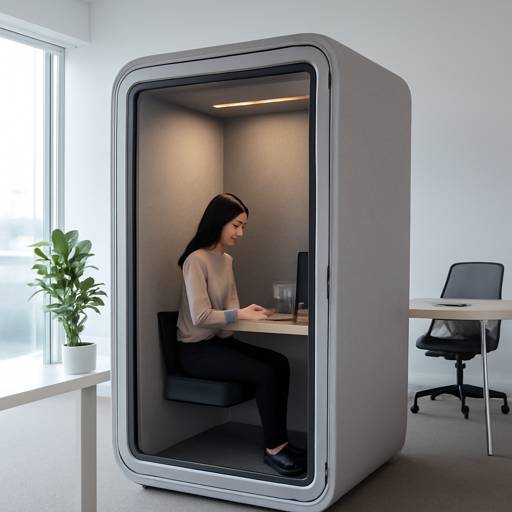
Lighting shapes energy and clarity. A high-CRI, flicker-free light with tunable color temperature maintains alertness across time zones and tasks, from relaxed ideation to camera-ready presentations. Thoughtful ergonomics—adjustable stool or chair options, work-surface height suited to typing and writing, and cable pass-throughs—prevents strain. Power and data access should feel effortless: integrated outlets, USB-C, and routing for Ethernet reduce clutter while supporting plug-and-play work. Transparent panels positioned at eye level protect privacy without causing the isolation that can drain energy over long days.
Safety and longevity reinforce value. Fire-aware material selection, sturdy frames, and replaceable wear parts help facilities teams maintain the asset over many move-ins and reconfigurations. Sustainability is more than a brochure claim: durable finishes, low-VOC components, and responsible sourcing support environmental goals while also keeping indoor air quality high. Cepheus premium office pods exemplify this user-first approach with a focus on precision fabrication, reliable acoustic performance, and details that make daily use intuitive, not fussy. When these fundamentals align, a booth stops being a novelty and becomes infrastructure.
Planning, ROI, and Real-World Examples
Space planning begins with demand mapping. Track where calls overflow, when ad-hoc huddles spike, and which teams need heads-down time versus frequent cross-functional sessions. A useful rule of thumb places one single-user pod per 8–12 employees in call-heavy groups, plus multi-user enclosures near collaboration zones. Distribution beats clustering: spreading booths across a floor reduces walking time, keeps noise localized, and ensures accessibility for time-sensitive calls.
Measure outcomes, not just inventory. Before deployment, record baseline noise levels, meeting room occupancy, and average delay to find an available space. After installing booths, monitor scheduling relief, call containment, and user satisfaction. Many organizations observe a measurable drop in ambient noise where people previously took calls at their desks. A quieter floorplate encourages deep work while shifting small meetings out of oversubscribed conference rooms—freeing those rooms for genuine group sessions that require screens and seating.
ROI emerges from time and flexibility. Consider the cost per minute of employee focus: if a pod returns even 15 minutes of uninterrupted work per person per day, the recaptured productivity can dwarf capital costs over a lease term. Add savings from avoiding construction, permits, and future demolition. Because booths are assets that move, reconfiguration accommodates team churn, M&A events, or pilot programs with minimal downtime. The result is a resilient workplace that adapts as quickly as project priorities change.
Case studies spotlight how execution turns into impact. A creative agency installed four single-user units near its production floor. Within one quarter, the team reported a 6 dBA reduction in peak noise during campaign sprints and cut missed client calls by half. In a fast-scaling SaaS company, multi-person pods placed near product pods—rather than far-flung corners—reduced “meeting sprawl” and trimmed formal room bookings by 32%, keeping large rooms free for all-hands and roadmap reviews. An HR department managing sensitive conversations adopted larger enclosures with enhanced sealing and easily cleanable surfaces, improving confidentiality and comfort for candidates.
Vendor focus can amplify results. Solutions purpose-built for everyday use—such as Cepheus premium office pods—favor reliability over gimmicks. Attention to speech privacy, breathable airflow, and intuitive power access makes pods feel like natural extensions of the workplace rather than bolt-on afterthoughts. Solid door closures, properly tuned absorptive interiors, and camera-friendly lighting deliver consistent call quality, which, in turn, encourages adoption. When people want to use the booths, facilities data quickly validates the investment through high utilization and tangible performance gains across teams.